
A D-Dimer test is a simple blood test that checks for a substance released when a clot in the body breaks down. Doctors often use it to help decide whether further blood clot testing is needed. It does not confirm a clot on its own.
What is a D-Dimer test?
The D-Dimer test is a blood clot test that measures a small protein fragment called D-Dimer. This fragment appears in the blood when the body forms and then breaks down a clot. In simple terms, when your body makes a clot and later starts dissolving it, tiny pieces are left behind, and a lab can detect them.
A healthcare provider may order this test through a facility such as Chughtai Lab when there is a clinical reason to check whether abnormal clotting activity might be present. It is a starting point, not the final word. Think of it as a helpful signal that tells your doctor whether the situation needs a closer look.
The test itself is straightforward. A small blood sample is taken from a vein in the arm, and the laboratory measures the level of this clotting marker. The result is then read alongside your symptoms and overall health picture.
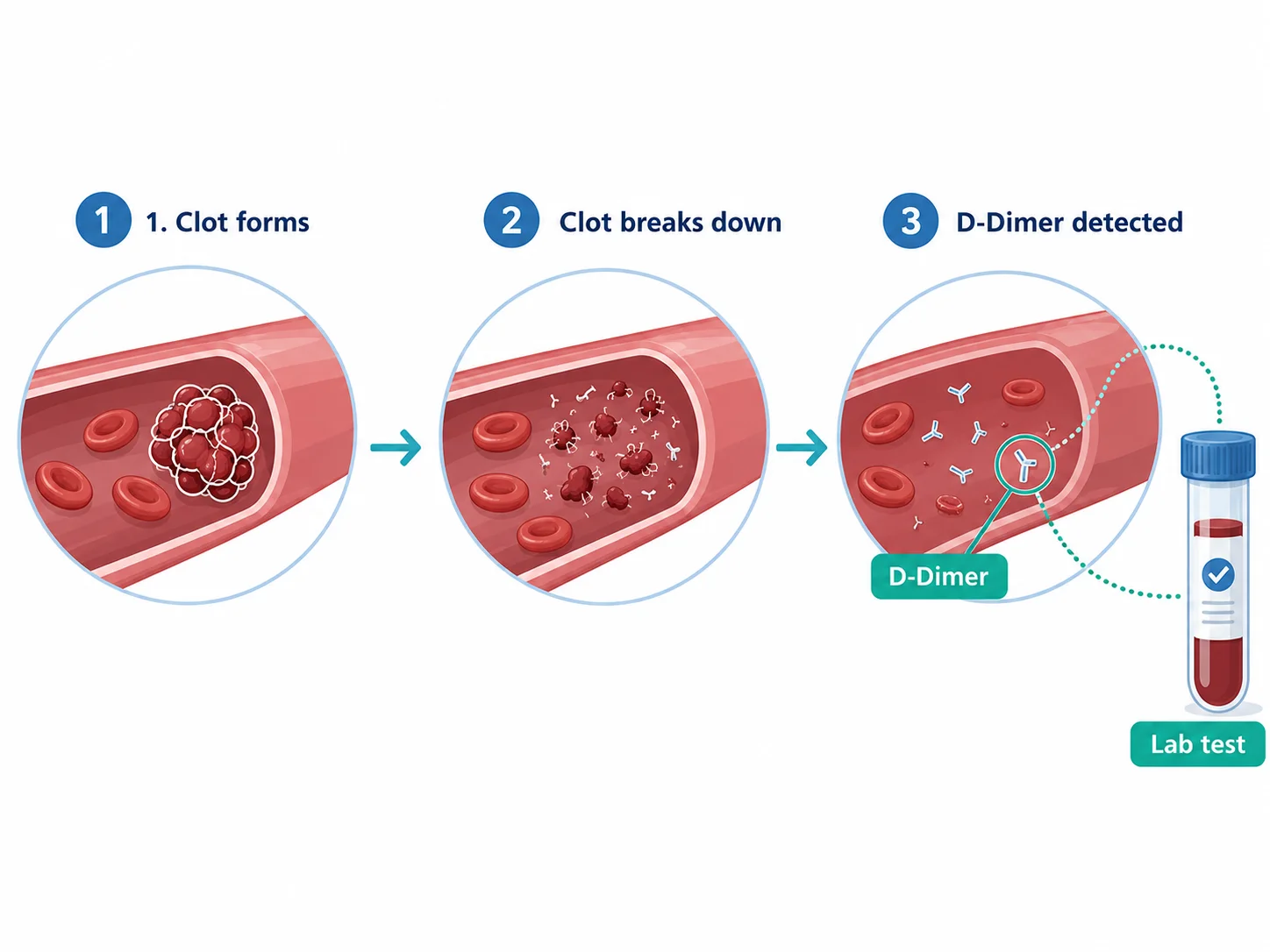
Why doctors may use D-Dimer for blood clot assessment
Clots can sometimes form inside blood vessels where they are not supposed to. When that happens, the body usually tries to break them down, and D-Dimer levels can rise. Because of this, the test can help assess whether a clot-related problem might be developing somewhere in the body.
A key strength of the D-Dimer test is its ability to help rule things out. When someone has a low likelihood of a clot based on their symptoms and risk factors, a normal D-Dimer result can give the doctor reassurance that a serious clot is unlikely. This can sometimes help avoid more complex testing when it is not needed.
The test is also useful because it is quick and minimally invasive. For many patients, it offers an early, low-risk way to gather important information before deciding on the next step.
What a high D-Dimer may suggest
A high D-Dimer can indicate that there has been increased clot formation and breakdown somewhere in the body. However, and this is important, a raised result does not point to one single cause. Many ordinary situations can push the level up.
D-Dimer can rise after recent surgery, during pregnancy, after an injury, with infection or inflammation, in older age, and in several other common conditions. Because the list of possible reasons is long, a high result is best understood as a prompt for more careful evaluation rather than an answer by itself.
This is why doctors never look at the number alone. A high D-Dimer simply tells the medical team that more thinking and, in some cases, more testing may be needed to understand what is going on.
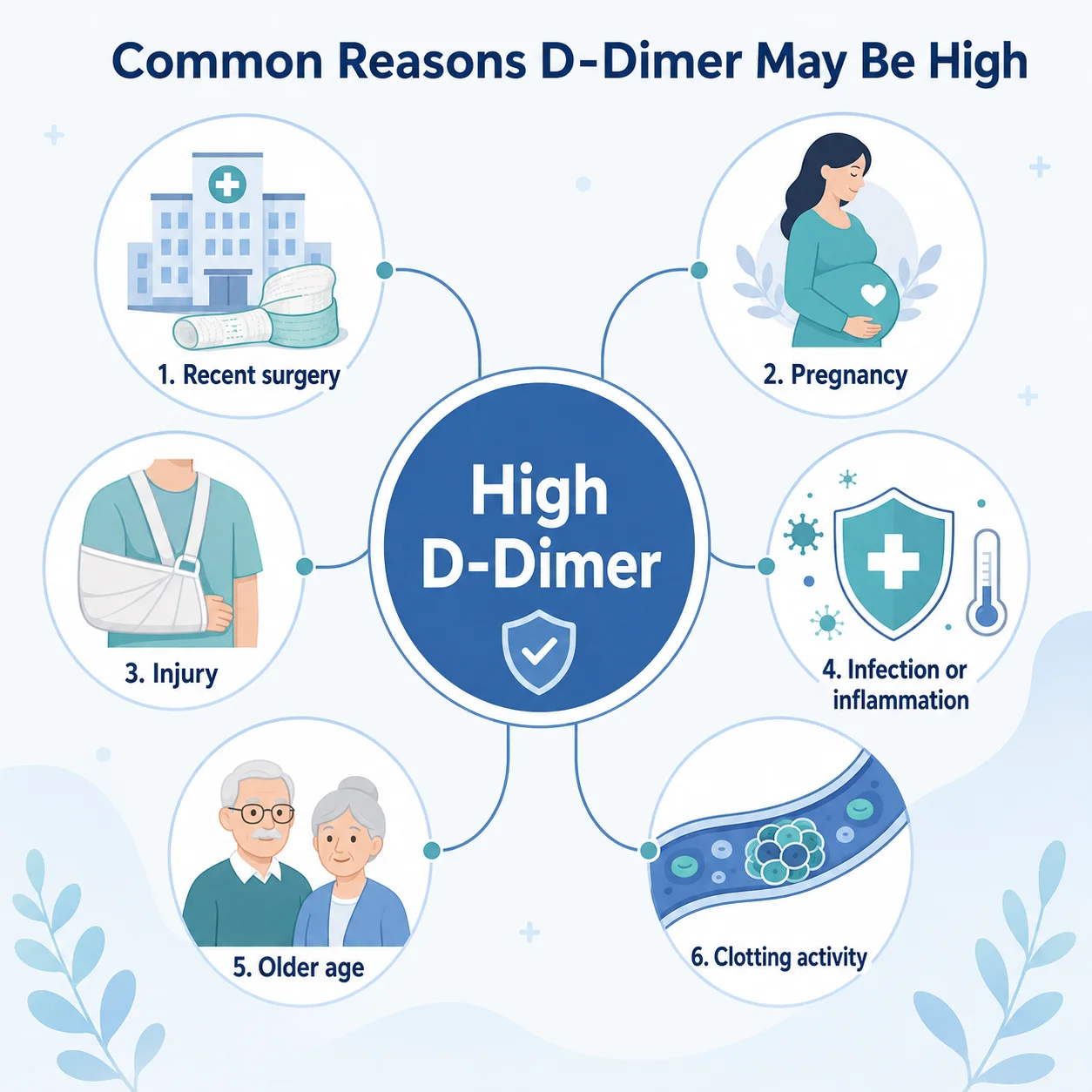
Why D-Dimer is not a final diagnosis
It helps to remember that this test is sensitive but not specific. Sensitive means it usually goes up when a clot is present. Not specific means it can also go up for many unrelated reasons. Because of this combination, a high D-Dimer cannot confirm a clot, and it cannot tell you where a clot might be.
Doctors interpret D-Dimer together with your symptoms, your personal risk factors, a physical examination, and sometimes imaging scans or additional laboratory tests. Only this complete picture allows a clinician to reach a reliable conclusion. The test is one piece of a larger puzzle, never the whole puzzle on its own.
So if your result comes back higher than expected, try not to panic. It is a reason for your doctor to investigate further in a calm, structured way, not a confirmation of any condition.
When doctors may recommend this test
A doctor may recommend a D-Dimer test when a person has symptoms or risk factors that raise a reasonable concern about abnormal clotting. The decision is always guided by a clinical assessment, not by the test alone.
Some situations where a doctor may consider this test include unexplained leg swelling or pain, breathing difficulty that needs explanation, or a combination of risk factors after an assessment. Ranges and cutoffs vary by lab and clinical context, so interpretation is always left to the treating physician who knows your full history.
The important takeaway is that this test is requested for a reason. It is part of a thoughtful process, and your doctor will explain why it fits your particular situation.
DVT and pulmonary embolism: how D-Dimer may fit into evaluation
Two conditions are often discussed alongside this test. DVT, or deep vein thrombosis, is a clot that can form in a deep vein, commonly in the leg. A pulmonary embolism happens when a clot travels to the lungs. Both are serious and need proper medical evaluation.
As a DVT test or a pulmonary embolism test component, D-Dimer is usually used as an early filter rather than a confirming tool. If the result and clinical picture suggest low risk, the doctor may feel reassured. If concern remains, imaging or further assessment is typically the next step. The test helps shape the path forward; it does not end the journey by itself.
This is also a good moment for an important safety reminder. Sudden chest pain, severe shortness of breath, fainting, sudden weakness, or a swollen, painful leg should be treated as a possible emergency. In these situations, seek urgent medical care right away rather than waiting for any test.
Related clotting tests you may hear about
D-Dimer is part of a wider family of tests that look at how your blood clots. Your doctor may mention some of these depending on your situation and what they need to understand.
You may hear about PT/INR and APTT, which look at how long blood takes to clot through different pathways. Fibrinogen measures a protein that is essential for clot formation, and a Platelet Count checks the cells that help start the clotting process. These tests answer different questions, and a doctor decides which ones are relevant for you. D-Dimer focuses specifically on clot breakdown, which is why it sits in its own useful position within this group.
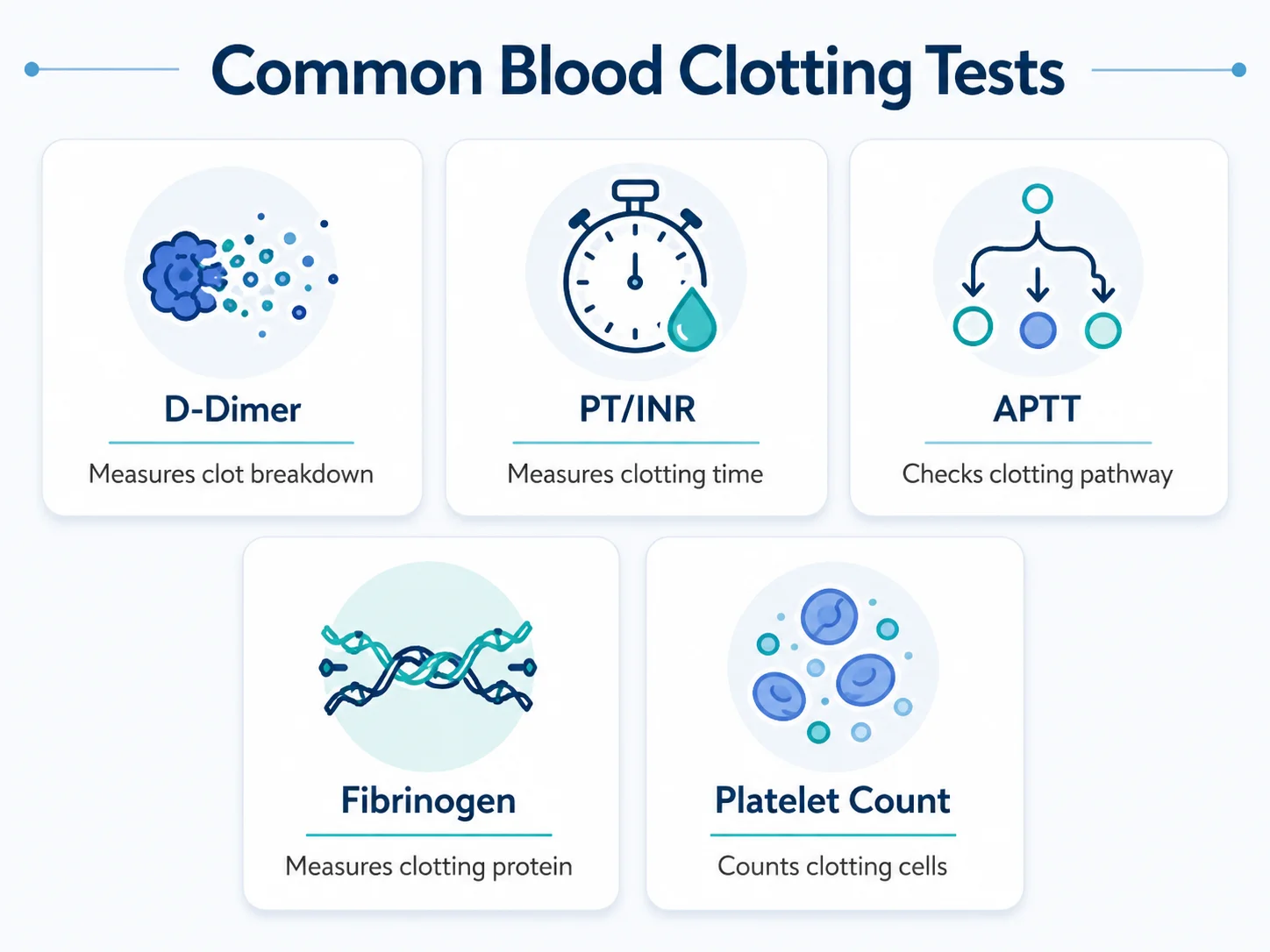
Preparation and common mistakes
One of the conveniences of this test is that it usually requires very little preparation. For most patients, no special fasting is needed, although you should always follow any specific instructions given by your doctor or the laboratory.
A common mistake is reading the result without medical guidance. Searching online and assuming the worst from a single number causes unnecessary worry. Another frequent misunderstanding is expecting the test to give a yes-or-no answer about a clot, when in reality it is designed to guide the next decision, not to deliver a verdict.
The best approach is simple. Have the test done as advised, and let your doctor interpret it within your full clinical context.
Important safety notes
This article is for general education and is not a substitute for professional medical advice. A D-Dimer result should always be discussed with a qualified healthcare provider who can consider your complete health picture.
Please do not use this information to self-diagnose or to delay care. If you have warning signs such as sudden chest pain, severe breathlessness, fainting, sudden weakness, or a painful, swollen limb, treat the situation as urgent and seek immediate medical attention. Early professional assessment is always the safest path.
FAQs
What is the D-Dimer test used for?
It is mainly used to help assess whether abnormal blood clotting activity may be present. Doctors often use it as an early step to decide whether further clot-related testing is needed.
Does a high D-Dimer always mean a blood clot?
No. A high D-Dimer can occur for many reasons, including infection, inflammation, recent surgery, injury, pregnancy, and older age. It signals the need for more evaluation rather than confirming any clot.
Can D-Dimer help with DVT or pulmonary embolism evaluation?
Yes, it can be part of the early evaluation for both DVT and pulmonary embolism. It usually helps guide whether further imaging or testing is needed, but it does not confirm these conditions on its own.
Do I need fasting for a D-Dimer test?
Generally, no special fasting is required for this test. Always follow any specific instructions provided by your doctor or the laboratory.
What other clotting tests may be done with D-Dimer?
Depending on the situation, a doctor may also consider PT/INR, APTT, Fibrinogen, or a Platelet Count. Each of these examines a different part of how blood clots.
Book Your TestIf your doctor has advised clot-related testing, you can have a D-Dimer test, along with supporting tests if recommended, done conveniently at Chughtai Lab. Speak with your healthcare provider first so the results can be interpreted within your full medical picture, and book your test when you are ready. |




