
Cytopathology Department - Accurate Cell Diagnostics

آپ کی صحت کا نمبر24/7

03-111-456-789

Cytogenetics Department

Home / Departments / Cytogenetics Department

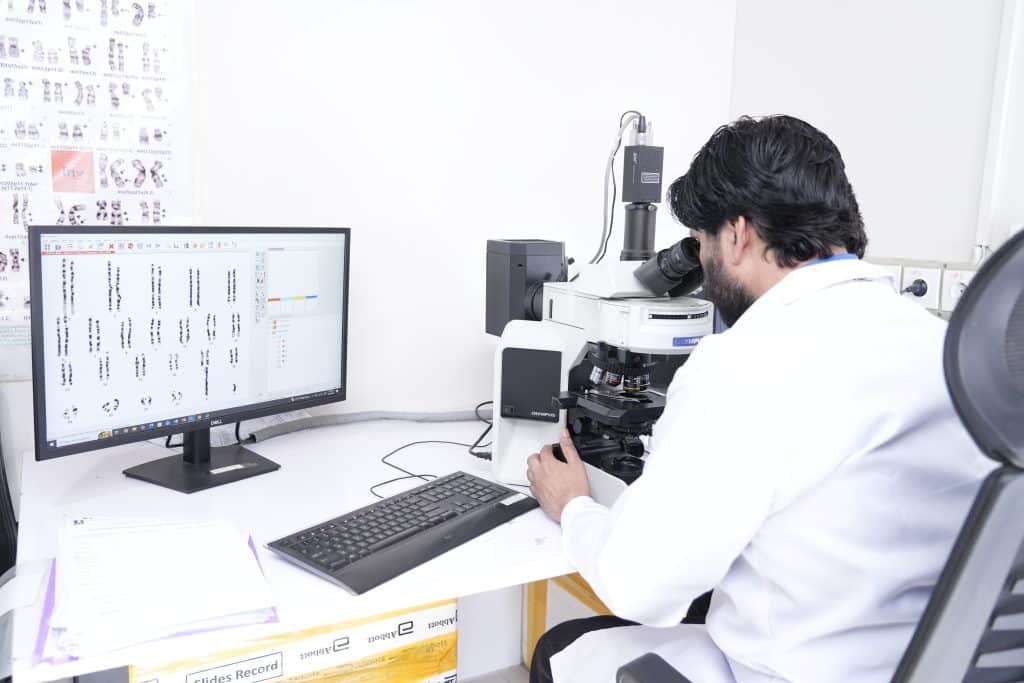
A Cytogenetics Department specializes in studying chromosome structure and function to diagnose genetic disorders, cancer diagnostics (leukemia), and congenital abnormalities. These labs utilize techniques like karyotyping, FISH (Fluorescent In-situ Hybridization).

Our department specializes in utilizing cutting-edge Cytogenetics technologies for a wide range of applications, including:

A. Chromosomal autosomal abnormalities
  • Sex chromosome abnormalities
  •  Primary amenorrhea
  •  Absent secondary sexual characteristics
  •  Short stature
  •  Infertility
  •  Problem in sexual intercourse
  •  Ambiguous genetalia
  • Couple with recurrent abortions
  • Couple with congenitally abnormal kid’s.
  • Cytogenetics study for Down’s syndrome
  • Cytogenetics study for Down’s syndrome Variations (Translocation, mosaic)
  • Cytogenetics study for Turner’s syndrome
  • Cytogenetics study for Turner’s syndrome Variations (mosaic, iso chromosome)
  • Cytogenetics study for Patau’s syndrome
  • Cytogenetics study for Edward’s syndrome
  • Cytogenetics study for Kline filter’s syndrome
  • Cytogenetic study for Kline filter’s syndrome Variation(mosaic)
  • Screening for Fanconi’s anemia or Chromosomal Breakage study
  • Acute myeloid leukemia cytogenetics study(M0-M7)
  • Acute lymphoblastic leukemia cytogenetics study (ALL1-ALL3)
  • Myelodysplastic syndrome cytogenetics (MDS)All types
  • Chronic myeloid leukemia cytogenetics study (CML)
  • Erythroid hyperplasia cytogenetics study
  • Invasive ductal carcinoma (Her2 by FISH)
  • Invasive breast carcinoma (Her2 by FISH)
  • Glioma 1p/19q co-deletion (Brain tissue by FISH)
Technologies Used
We employ a variety of advanced technologies, including:
  • Conventional cytogenetics study
  • Karyotyping Advance Cytovision software
  •  Fluorescent In-situ Hybridization (FISH)
Current Parameters
Our current parameters cover a broad spectrum of Cytogenetics analyses, including:
  • Chromosomal Analysis/Karyotyping from Blood (Test Code: 3519)
  •  Cytogenetic Study for Hematological Malignancies from Bone Marrow or Peripheral Blood (Test Code: 3528)
  • Chromosomal Breakage Analysis for Fanconi’s Anemia (Test Code: 1384)
  •  BCR-ABL Fusion Detection by FISH (Test Code: 3531)
  •  PML-RARA Fusion Detection by FISH (Test Code: 3530)
  •  HER2 Amplification Detection by FISH (Test Code: 3485)
  •  TP53 Gene Mutation Detection by FISH (Test Code: 5544)
  •  1p/19q co-deletion Detection by FISH (Test Code: 2123)
Purpose of Karyotyping/Cytogenetic analysis and FISH test its limitation?
  •  This assay allows for microscopic visualization of numerical and structural chromosome abnormalities. The size of structural abnormality that can be detected is >3-10Mb, dependent upon the G-band resolution obtained from this specimen. For the purposes of this report, band level is defined as the number of G-bands per haploid genome. It is documented here as “350”, i.e., the range of bands determined from the four karyograms in this assay. Detection of heterogeneity of clonal cell populations in this specimen (i.e. Mosaicism) is limited by the number of metaphase cells examined, documented here as “20 # of cells counted”.
  •  Fluorescence in Situ Hybridization (FISH) is used to detect whether specific DNA sequences are present, absent or rearranged. It is performed on either interphase nuclei or metaphase chromosomes. FISH can only detect aberrations within the target region of the probe(s) applied.

    .

Genetic counseling support

Aiding clinicians in diagnosis, prognosis, and treatment planning

Research and innovation

Exploring genomic instability, congenital disorders, and personalized medicine

Reporting according to ISCN 2020 An international system for Human Cytogenetics Nomenclature (2020)